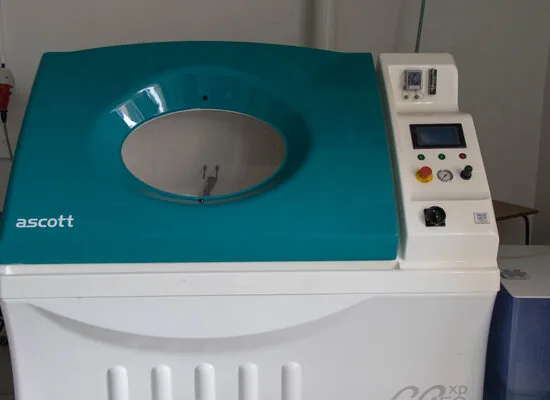
Salt Spray Chamber is part of the Corrosion Laboratory infrastructure at ITU Surface Lab. This page summarizes where the device sits in the laboratory workflow, what kind of measurements or process steps it supports, and why it matters in applied surface engineering studies.
In practice, the device is used to compare coating behavior, process stability, microstructural response, or surface-related performance outputs under controlled research conditions. The goal is not only to list the equipment, but to clarify the role it plays in experiment design and interpretation.
The summary, metadata cards, and detailed content below connect the device to real laboratory questions such as deposition strategy, corrosion response, tribological performance, characterization depth, or data reliability across projects and publications.
Specifications Temperature Range Adjustable from ambient to +50°C/+122°F (Option ACC03 increases temperature range from ambient to +60°C/+140°F) Salt Spray Fall-Out Rates Adjustable from 0.5 to 2.5 ml per 80 cm2 per hour Wetting Mode Adjust
| Specifications |
|
|---|---|
| Temperature Range | Adjustable from ambient to +50°C/+122°F (Option ACC03 increases temperature range from ambient to +60°C/+140°F) |
| Salt Spray Fall-Out Rates | Adjustable from 0.5 to 2.5 ml per 80 cm2 per hour |
| Wetting Mode | Adjustable from ambient to +50°C/+122°F |
| Drying Mode | Adjustable from ambient to +50°C/+122°F |
| Chamber Construction | Glass reinforced plastic, Polypropylene & PVC parts |
| Color | 9 standard colors to choose from. |
| Water | Deionized/distilled for topping up air saturator and making salt solution. Air saturator requires a continuous water connection 2.0-5.0 bar (29-72 psi). If air saturator is topped up manually option ACC66 must be ordered. |
| Air | Clean dry & oil free, 4.0 to 6.0 bar (58-87psi) with 240 Ltrs (8.5cu.ft) per minute flow |
| Exhaust | 3m (10ft) exhaust pipe is provided which should be terminated outside building |
| Drain | 3m (10ft) drain pipe provided which should be terminated into floor level drain |
| Operating Environment Conditions | +18 to +23°C (+64 to 73°F), 85% max RH (non condensing) ambient |
Related Guides
What Is Salt Spray Testing?
See how accelerated exposure supports coating comparison and failure screening.
Corrosion Test Methods
Use a broader testing frame to connect salt spray, electrochemistry, and surface evidence.
How to Interpret Pitting Corrosion
Read local damage, passive breakdown, and environment-driven attack together.
Electrochemical Characterization
Move from raw electrochemical curves to corrosion and interface interpretation.
What Is Electrochemical Impedance Spectroscopy?
Interpret coating barrier behavior and interface changes through impedance response.