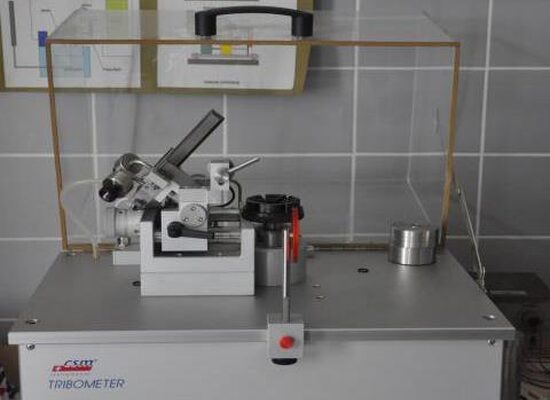
Pin-On-Disc Tribometer is part of the Characterization Laboratory infrastructure at ITU Surface Lab. This page summarizes where the device sits in the laboratory workflow, what kind of measurements or process steps it supports, and why it matters in applied surface engineering studies.
In practice, the device is used to compare coating behavior, process stability, microstructural response, or surface-related performance outputs under controlled research conditions. The goal is not only to list the equipment, but to clarify the role it plays in experiment design and interpretation.
The summary, metadata cards, and detailed content below connect the device to real laboratory questions such as deposition strategy, corrosion response, tribological performance, characterization depth, or data reliability across projects and publications.
Features > Precisely calibrated friction and wear measurements > Stable contact point and no parasitic friction > Variable sample sizes and shapes > Test in liquids and controlled humidity > Testing compatible with ISO and ASTM Options > El
Features
> Precisely calibrated friction and wear measurements
> Stable contact point and no parasitic friction
> Variable sample sizes and shapes
> Test in liquids and controlled humidity
> Testing compatible with ISO and ASTM
Options
> Electrical contact resistance
> Reciprocating (Linear mode)
> Liquid heating
> Continuous wear depth measurement
> Compact profilometer Co
> Vacuum setup
Related Guides
Surface Characterization Methods
Use the broader interpretation map that connects imaging, chemistry, and topography.
How to Interpret SEM-EDS
Tie morphology and composition together to read coatings and degradation behavior.
How to Interpret XRD
Use phase and crystallographic information to support coating interpretation.
What Is Profilometry?
Move from height maps to roughness interpretation and surface process decisions.
Tribology and Wear
Follow how friction, wear, and coating durability are interpreted together.
Tribology Test Methods
Follow how wear tracks, friction curves, and coating integrity are read together.
How to Interpret Coating Hardness
Connect hardness, elastic response, and failure mode instead of reading one number alone.